Skip to content

RPX Benchmark Toolkit

Bring your model. We bring the dataset, the splits, the metrics, and the tables.

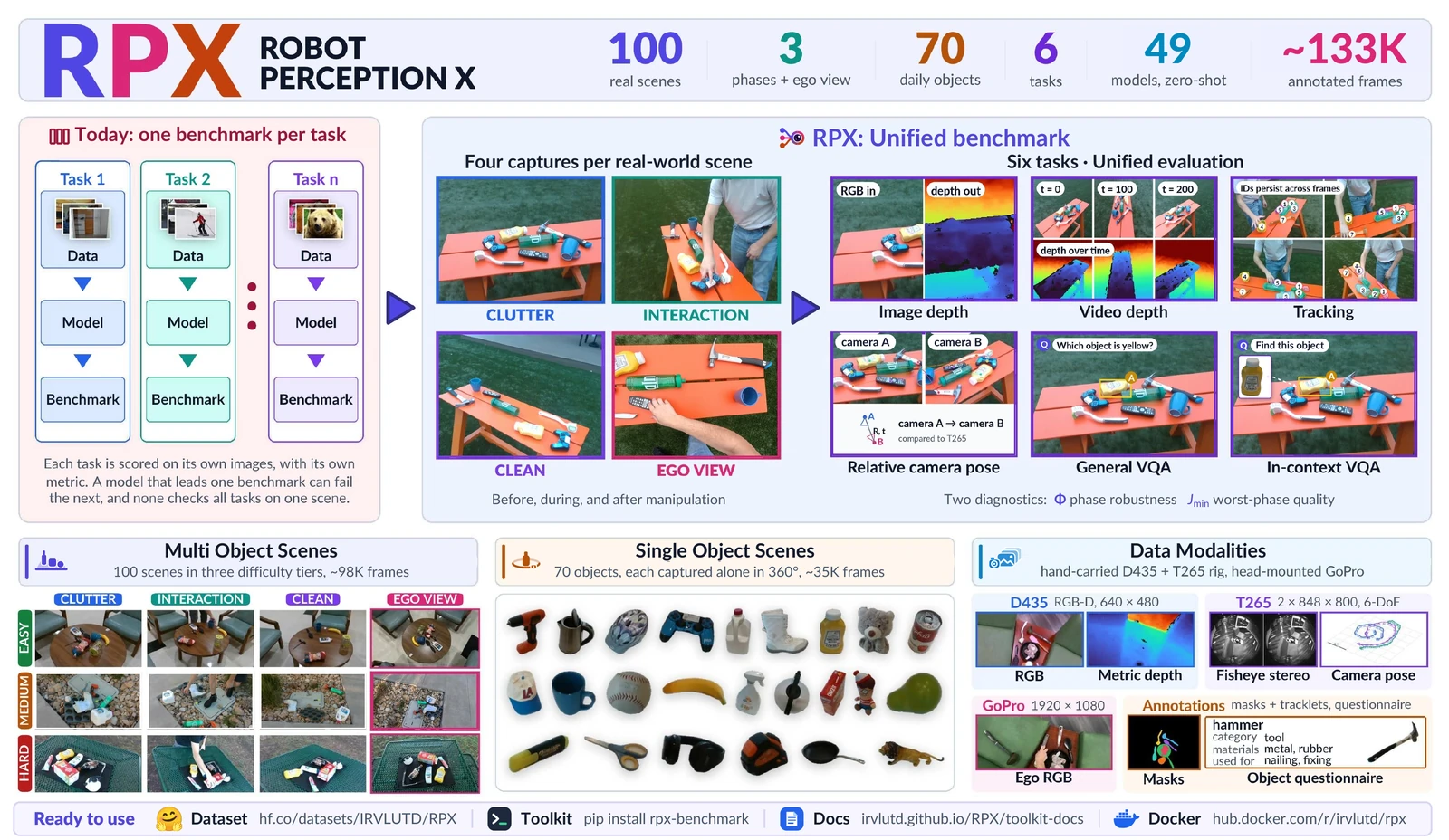
RPX enables you to choose and rank perception models for robot learning — on real-world RGB-D data, under embodied deployment conditions, with ESD-stratified difficulty splits and deployment-readiness scoring.

rpx-benchmark is the reference toolkit for RPX — Robot Perception X, a unified real-world RGB-D benchmark for evaluating the perception models actually deployed inside robot learning stacks (not generic perception leaderboards). It is built so a researcher can run an off-the-shelf HuggingFace model on an RPX difficulty split in one command, compare results across the slate of robot-learning backbones, and a team can add a whole new task or metric in one file.

pip install 'rpx-benchmark[depth]'

rpx bench monocular_depth \
    --hf-checkpoint depth-anything/Depth-Anything-V2-Metric-Indoor-Large-hf \
    --split hard

That line downloads only the RGB + depth files the Hard split references (via HuggingFace), loads the model, runs inference with a live progress bar, prints an ESD-weighted phase-score table, measures FLOPs and median latency, and writes result.json + summary.md.

No Python code required.


Five-minute tour

  • Quickstart


    Install, run your first benchmark, and read the output tables.

  • :material-plug: Bring Your Own Model


    Three paths: zero-code HF checkpoint, numpy callable, or custom adapter stack.

  • Architecture


    How the adapter framework, metric registry, and task registry fit together.

  • Extension Guides


    Add a new task, metric, or model adapter in one file.


What RPX is

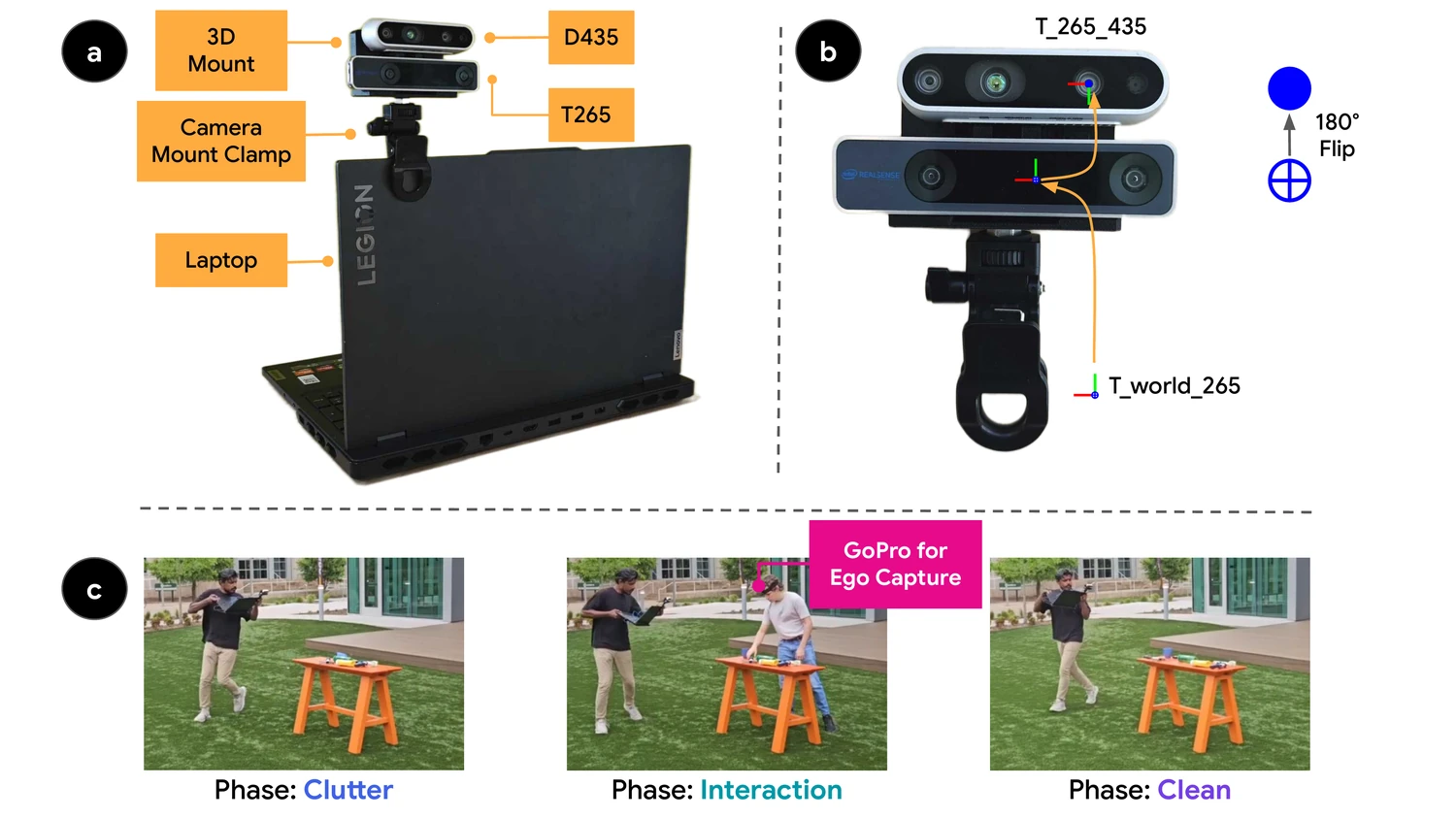
  • 75,000 frames across 100 indoor scenes, captured with an Intel RealSense D435 (RGB-D) + T265 (6-DoF VIO) rig.
  • Three-phase capture protocol: each scene is recorded under ClutterInteraction (human grasps/moves objects) → Clean. This isolates scene reconfiguration from scene identity so performance deltas mean something.
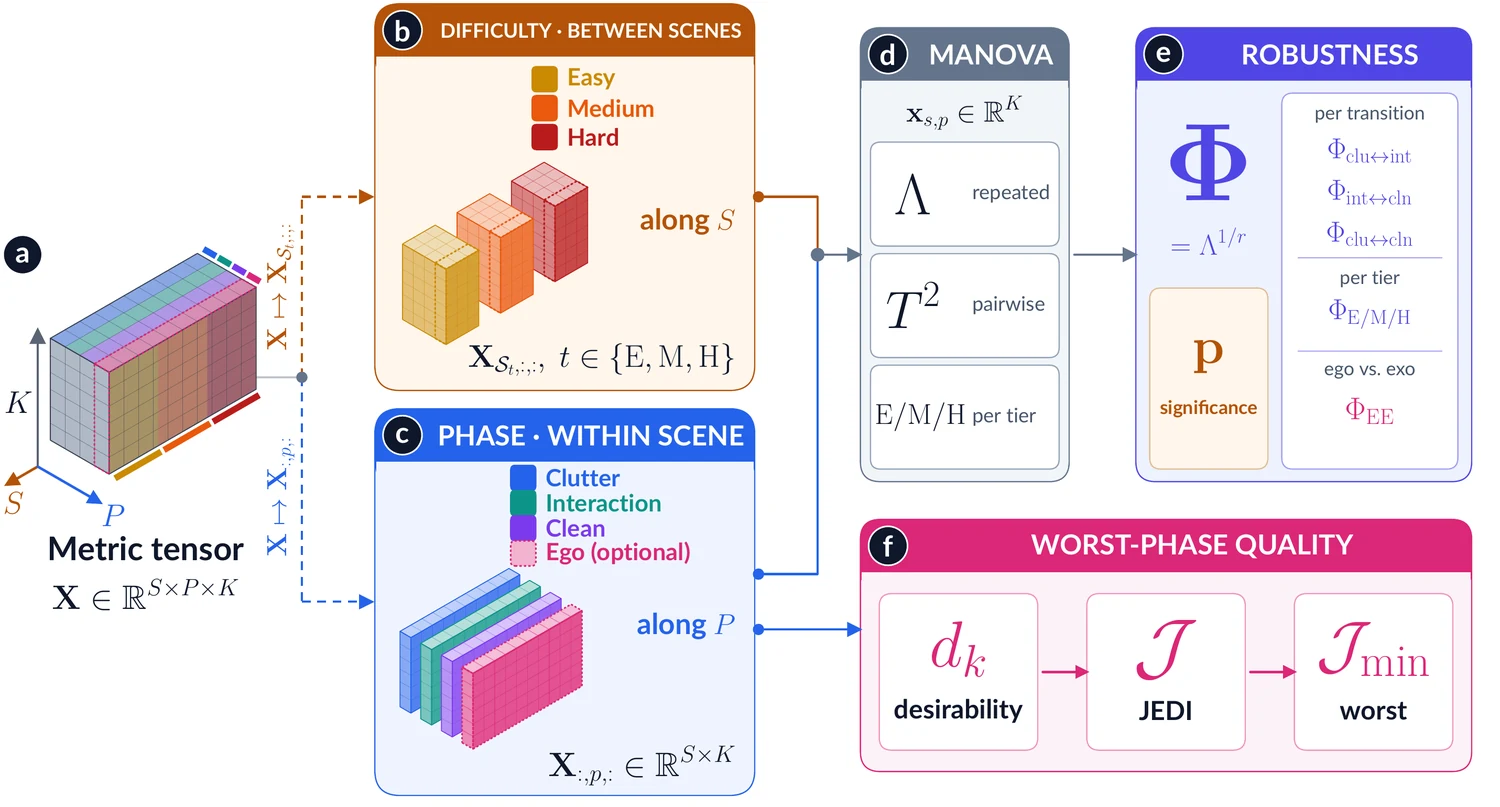
  • Effort-Stratified Difficulty (ESD) splits per (scene, phase) — Easy / Medium / Hard derived from real annotation effort.
  • Ten benchmark tasks on identical scenes: monocular absolute depth, object segmentation, object tracking, object detection, open-vocab detection, visual grounding, sparse depth, relative camera pose, novel view synthesis, keypoint matching.
  • Scoped first-class around models used as backbones in robot learning, not generic perception SOTA.

Design principles

  1. The only variable should be the model. Datasets, splits, metrics, reports, and deployment-readiness scoring are fixed.
  2. Adding a new task or metric should touch one file. Plugin registries for models, metrics, and tasks make this a hard invariant.
  3. Errors should tell the user what to fix. Every raised exception is a subclass of rpx.exceptions.RPXError and carries a hint line.
  4. Documentation is the docstrings. This site is built from them automatically via mkdocstrings. No separate rewrite exists or will exist.
  5. CPU-first, CUDA-aware. Every pipeline auto-falls-back to CPU with a clear warning when CUDA isn't available.

Repository

https://github.com/IRVLUTD/RPX

License

  • Benchmark toolkit: MIT
  • RPX dataset: CC BY 4.0