




 99% at 1,688 m

Map Completion
“What does the unseen space look like?”
Synthesizes geometry with a generative model, paying in parameters, data and latency for detail the planner never consumes.
MapEx · UPEN · IG-Hector
Under Review
1Intelligent Robotics and Vision Lab, The University of Texas at Dallas 2Cornell University 3University of Florida
Autonomous exploration requires a robot to decide where to move next based on what it has observed so far. Classical frontier methods only use the geometry of the occupancy grid and commit to targets that yield little new coverage at the cost of longer traversal. Recent learned methods instead complete the unseen map with a generative model, which synthesizes geometry the planner never consumes and risks hallucinating structure. In this paper, we show that exploration needs only an estimate of how much new area a candidate goal would reveal. We propose IntelX, a framework that learns this estimate with a single lightweight U-Net, regressing coverage gain densely over a robot-frame occupancy image under supervision from a simulation oracle that measures the coverage actually obtained from every reachable nearby goal. The network returns the field over a 20 m window in 8.1 ms, and because its input is an occupancy image it can potentially adapt to other sensor configurations. We show that the same field also exposes topological structure, with junctions appearing as multi-peaked angular mass. The IntelX planner commits to their branches weakest-first, clearing terminating branches before corridors that stay reachable later. Our experiments on three held-out floor-plans and three out-of-distribution corpora show that IntelX reaches the 99% coverage target on large maps over paths more than 20% shorter than any of the eight baselines that also reach it, achieving high area covered per meter and per second efficiencies.
Run IntelX on a floor plan of your own, entirely in your browser. Pick an example, draw walls and rooms, or upload a map (a ROS map, or any image with dark walls on a light floor), then press Start. The page downloads the trained U-Net (26 MB) and runs it on your graphics card through WebGPU, or on the processor where WebGPU is unavailable. The simulator and both planners are a direct port of the released code, with the benchmark's sensor and settings, and nothing you draw or upload leaves your computer.
Note: the demo runs a smaller, compressed copy of the IntelX network, its weights stored at 8 bits instead of 32 to keep the download small. It may be less accurate than the full model evaluated in the paper, and by default it also predicts less often than the paper's runs (every 30 cm, or 60 cm on a processor, instead of 5 cm), so results here can differ from the paper's.
To decide where to go next, a robot does not need to imagine the rooms it has not seen. It needs one number for every goal around it: how much new area it would reveal by standing there. IntelX learns that number with a single lightweight U-Net, and reads the structure of the building straight off the same field.
Map Completion
“What does the unseen space look like?”
Synthesizes geometry with a generative model, paying in parameters, data and latency for detail the planner never consumes.
MapEx · UPEN · IG-Hector
End-to-End Policies
“Where should I go?”
Folds perception and strategy into one network that needs interaction data and gives no account of its decisions.
Reinforcement and imitation learning
IntelX
“How much new space would I gain by standing there?”
A supervised regression target with a simulation oracle. No generative model, and directly actionable.
One U-Net · One field · Two planners
Path to 99% (P99) among the methods that complete each held-out map, 20 trials per map (Table 3).
Local decisions are learned, since the value of a nearby goal turns on geometry too subtle to hand-design. Global decisions are not, since indoor structure is discrete and legible: junctions are read off the same field as multi-peaked angular structure and managed with explicit memory rather than a second network.
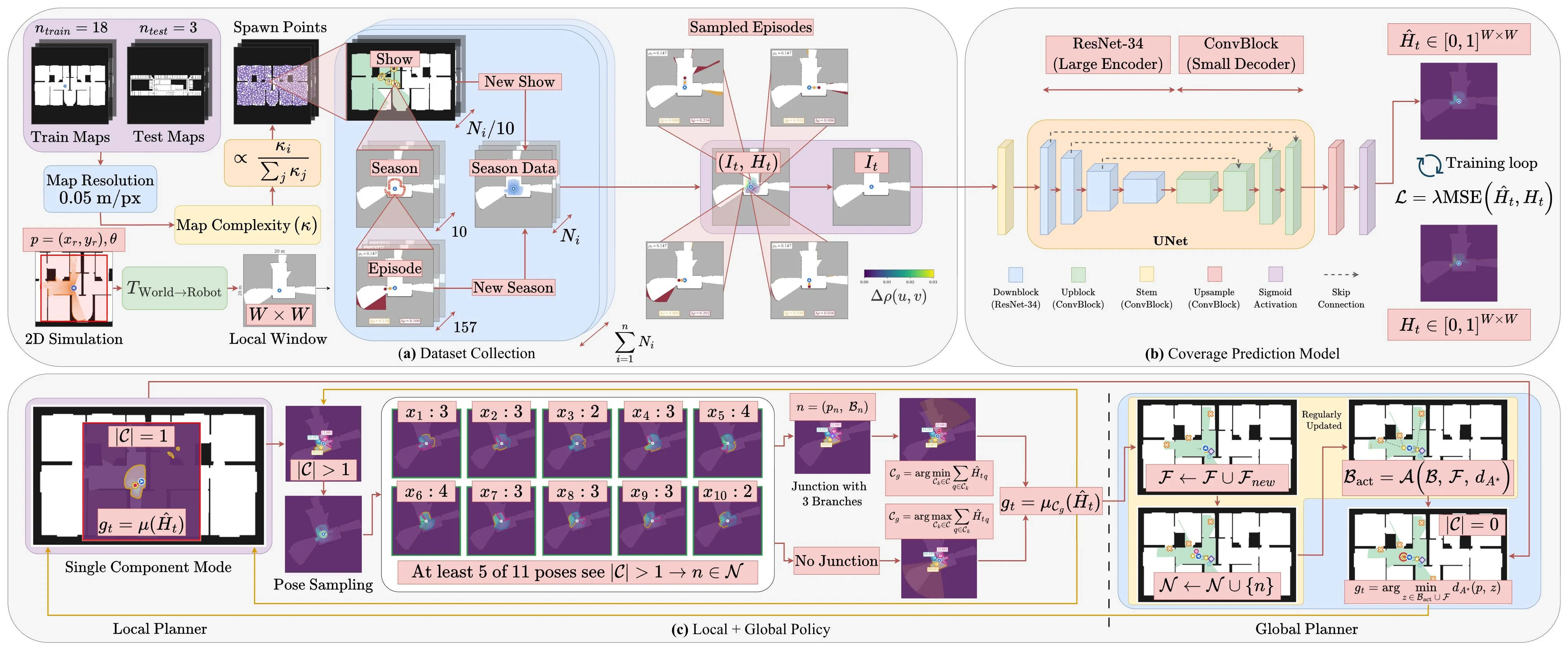
A custom 2D simulator ray-casts a 220° laser of 662 beams out to 10 m over 18 floor plans, standardized to 0.05 m per pixel and sealed watertight. A show walks outward from a seeded spawn through 10 seasons. At each season, 157 goals on a 2.5 m ring are replayed as episodes from the frozen state, and the coverage gain Δρ that each one actually yields is recorded along its path. Every season becomes one training pair of a robot-frame occupancy image It and its field Ht: 106 pairs from 100,000 shows, collected by up to 720 concurrent simulators.
Shows per training map (Table 1), allocated in proportion to a complexity score κ that balances room count against explorable area, so the large offices that carry junction structure are not starved. Hover a bar for its rooms, area and κ.
Given the robot's local scan image It, the network regresses the expected coverage gain Δρ at every pixel of the 20 m window. It is a U-Net with a ResNet-34 encoder at depth 5, adapted for single-channel input and trained from scratch. Four decoder stages of width 256, 128, 64 and 32 with bilinear upsampling and skip connections end in a sigmoid over the 400 × 400 window, 24.4 M parameters in all.
Training uses a weighted MSE (λ = 108), which keeps the gradients of gains as small as 10−4 clear of the FP16 denormal range. Because the input is an occupancy image, the same predictor can be retrained for other ranges, fields of view and beam counts, confining the sim-to-real gap to how occupancy is rendered.
The field is smoothed and its mass gathered into a 72-bin angular histogram around the robot. Its peaks split the window into angular components, and when a single component survives, its intensity-weighted centroid becomes the goal. The global maximum sits deep inside a room, and one centroid over the whole field lands almost on the robot, since opposing lobes cancel. The component centroid is the only goal far enough to be worth travelling to and near enough to explore the room completely.
| Goal | Distance [m] | Δρ |
|---|---|---|
| (a) Global Maximum | 2.5 | 0.0168 |
| (b) Weighted Centroid | 0.3 | 0.0085 |
| (c) Component Centroid (IntelX) | 1.5 | 0.0168 |
| (d) Frontier Centroid | 6.6 | 0.0168 |
The global planner turns multi-peaked structure in the field into persistent, rankable branches. A junction registers only when at least 5 of 11 poses, the robot and 10 virtual poses on a 0.5 m circle, see more than one component. A branch's strength predicts what lies beyond it: a weak branch ends in a room or a dead end, while a strong one opens onto a corridor. Clearing the weak branch first costs a short detour now instead of a long return later.
Each trial draws one spawn by seeded rejection sampling and every method runs from that pose, so a difference between methods is attributable to the policy rather than the start. Below, the trials of the paper's Fig. 6 and of the supplementary video are replayed for all nine methods, synchronized by distance travelled: the three held-out KTH floor plans, seven out-of-distribution maps from HouseExpo, Modified Swiss Dwellings and AWS RoboMaker, and the fourth floor of the ECSS building at UT Dallas, a map built with SLAM from a real robot's laser scans. Pick a map, then play or scrub; hovering over a method highlights its coverage curve.
20 trials per map; P99 averages only the runs that reach ρ⋆ = 99%. Among the methods that complete a map, IntelX takes the shortest path on all three.
10 trials per map. Primed path lengths are per-map ratios to the best method, so 1.00 means shortest.
MapEx is the closest competitor, and the comparison is not uniform over a run. Below 80% coverage it leads IntelX on roughly half the runs, since predicted completions pay off while large unseen regions remain. Above 90%, its curve flattens as the remaining gain falls below its prediction resolution, and IntelX overtakes. The same effect favors MapEx on smaller maps, where the floor plan is close to its prediction horizon and the late phase is short.
Coming soon. The BibTeX for the paper will be posted here once it is on arXiv.

